

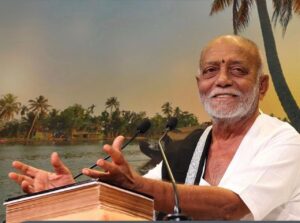
Where nature meets spiritual grace
GUJARAT | 01st AUGUST 2026 | A journey through the history of Morari Bapu’s Ramkathas reveals a significant milestone. It was in April 1976 that Bapu’s Vyaspeeth crossed India’s shores for the first time, with Nairobi, Kenya, hosting his maiden Ramkatha abroad. The principal hosts of that historic discourse were Ramaben Jasani and her family.
From that moment onwards, the Jasani family became deeply immersed in the spirit of Ramkatha. Even after five decades, that devotion has not diminished. If anything, it has grown stronger with each passing year. Today, the third generation of the family continues to organise Bapu’s Ramkathas, bearing testimony to a legacy of faith and service.
The branches of this devotion have extended beyond Ramaben’s immediate family to her siblings and their families. Consequently, this large family, now spread across different parts of the world, has remained devoted to Bapu’s Vyaspeeth for nearly half a century. Most recently, it was the seven daughters of this extended family, much like the seven leaves of the sacred Saptaparni tree, who lovingly shouldered the responsibility of organising Bapu’s Ramkatha in Kochi, Kerala.
From 13 to 21 June, Bapu’s Ramkatha was held in Kochi, often described as the ‘Queen of the Arabian Sea’. Kochi-Ernakulam is situated on a breathtaking stretch of India’s south-western coast, nestled between the Arabian Sea and the majestic Western Ghats.
Barely 40 kilometres away lies the sacred town of Kalady, the birthplace of Adi Jagadguru Shankaracharya. This region is therefore blessed not only with the abundance of nature but also with the rich heritage of Indian philosophy and spiritual inquiry. It is a land where breathtaking landscapes coexist with profound metaphysical wisdom. Against this backdrop, Bapu’s Ramkatha unfolded, creating a harmonious confluence of nature’s beauty and spiritual grandeur.
Exactly 50 years earlier, in 1976, Bapu had delivered a Ramkatha in Kochi. Much has changed since then, with the Talgajarda Vyaspeeth evolving significantly in both its outward expression and inner journey.
Returning to Kochi after five decades, and travelling more than 2,000 kilometres from Talgajarda, Bapu centred this Ramkatha on the theme of Manas-Mrityulok, or the mortal world. While the 2011 Ramkatha in Sydney, Australia, titled Manas-Mrityu, sought to dispel the fear of death by illuminating its deeper significance, the Kochi Ramkatha celebrated the profound value of Mrityulok itself.
Describing the earthly realm as a great school of learning, Bapu placed it above even the heavenly worlds in terms of its spiritual significance. He observed that it is only in this mortal world that one encounters tears and shelter, joy and surrender. It is here that the world’s sacred scriptures have emerged, and here that the Divine has chosen to incarnate.
Drawing upon the Shvetashvatara Upanishad, Kaivalya Upanishad, Kathopanishad, Shankar Vedanta, as well as classical and folk literature, Bapu reflected upon the meaning of death, the significance of human existence and the glory of the mortal world. Rather than fearing death, he advocated accepting it with serenity, dignity and reverence, seeing it as an integral part of life’s eternal journey.
An equally distinctive feature of Bapu’s Ramkathas is the evening cultural gathering, affectionately known as the Prem Sabha. These informal sessions have a charm of their own. Poets, musicians, scholars and artists present their work, while everyone, from young children to the elderly, is encouraged to express themselves in their own way. For a couple of hours each evening, the stage becomes an open forum where creativity, devotion and dialogue come together naturally.
During the Kochi Ramkatha, Saurabh Shah and Bhadrayu Vachharajani shared their thoughts, while Nitin Vadgama, Parth Hariyani and Swami Nijanand recited their poetry. The audience was also treated to musical presentations by storyteller Murlibaba, Kabirpanthi singer Krishnadas Saheb, exponents of the Warkari tradition and several other artistes. Adding a touch of humour to the proceedings, noted folk litterateur Bharatdan Gadhvi delighted the audience with his engaging performance.
Under the leadership of Nileshbhai, fondly known as Tinabhai Jasani, and with the wholehearted support of other members of the extended family, this Ramkatha blossomed into a true Prem Yajna, a sacred offering of love and devotion.
Bapu often emphasises that the successful organisation of a Ramkatha rests upon three essential pillars: Vyavastha (efficient organisation), Avastha (the right atmosphere) and Aastha (faith). All three found their fullest expression during the Kochi Ramkatha.
Set amidst Kochi’s captivating natural beauty and deeply devotional ambience, the Ramkatha offered every listener an experience that was both spiritually uplifting and deeply enriching. Those present returned with a sense of inner illumination, enriched by Bapu’s reflections and touched by the warmth, grace and heartfelt hospitality that characterised the entire occasion.
== ENDS ==