

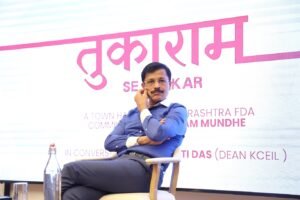
GANDHINAGAR, GUJARAT | 26th SEPTEMBER 2026 | Maharashtra Food and Drug Administration (FDA) Commissioner Tukaram Mundhe interacted with students at Karnavati University in a nearly two-and-a-half-hour session on leadership, public responsibility and food safety, during his first visit to Gujarat on Saturday.
The event, titled ‘Straight Talk with Maharashtra FDA Commissioner’ and featuring the theme ‘Tukaram Se Takkar’, gave students an opportunity to hear about Mundhe’s career in public service, the challenges of taking difficult decisions and the principles that guide his work.
Addressing the students, Mundhe said that having a clear vision must be matched by honesty and consistency in action. “I do not fear anyone because my conscience is clear. My work is for society and for its betterment. I want to help build a future that is healthy, liveable and disease-free,” he said.
A major part of the interaction focused on food safety and its wider implications for public health. Mundhe said that while registration and licensing requirements were being followed, compliance with other food safety regulations remained a concern. He argued that the impact of food and beverages on health was not always fully recognised, and pointed to the growing burden of non-communicable diseases (NCDs), including cancer, diabetes, hypertension and cardiac conditions.
“Today, non-communicable diseases account for 65 to 70% of the total disease burden in India. This has a direct correlation with what we eat. The sooner we understand that food safety is a public health issue, the better it will be for us,” he said.
Drawing on his experience at the Maharashtra FDA, Mundhe said enforcement should extend beyond inspections and action against violations. He emphasised the need to build awareness among food businesses and restaurant owners so that safe practices become an understood responsibility, rather than a response to regulatory action.
“For me, the decoration or colour of food is not important. What matters to me is public health and safe food. That is my responsibility,” he said.
Mundhe also discussed the responsibility of advertisers and public figures who endorse food and healthcare products. He said laws and regulations were in place to address misleading claims, but needed to be implemented stringently.
Mundhe also discussed efforts to protect children from unhealthy food environments. He said attractive advertising, packaging and the easy availability of junk food near schools can influence children’s choices.
He referred to measures being undertaken in Maharashtra to restrict the sale, advertisement and free distribution of high-fat, high-sugar and high-salt (HFSS) food products within 50 metres of school premises. The measures also encourage schools to promote healthier options, including fruits, vegetables, pulses, whole grains and dairy products, he said.
During the Q&A session, a student asked how the impact of Mundhe’s work could continue after he leaves his current post, particularly if his successor takes a different approach. Mundhe underlined the importance of creating lasting awareness among businesses and other stakeholders.
He said meaningful change would come when food businesses understood that public health must take precedence over short-term financial gains and followed safe practices as part of their own responsibility. The aim, he said, should be to address problems in a way that reduces the need for repeated corrective action.
The session also touched on the importance of choosing the ethical path and remaining guided by one’s principles. It concluded with a message to students that leadership is not defined solely by position or authority, but by purpose, accountability and a willingness to work for the wider good.
== ENDS ==